


DSM-5-TR Differential Dx
4.454.00 Reviews
App Specs
- Version
- 2.8.47
- Updated On
- License
- Free
- Downloads
- 100,000+
- Developer
- Unbound Medicine, Inc
- Categories
- Medical
- Platform
- Android
Screenshots
 Analysis by AppCompare
My first-week question with any reference app is simple: does it help me do something more clearly, or does it just look useful on the phone? With DSM-5-TR Differential Dx, the appeal is the chance to move from a broad clinical question toward a more organized comparison of possible diagnoses. I would treat it as a structured reference for thinking, not as a shortcut to a conclusion. That distinction matters from the first use: diagnostic judgment still belongs to the qualified person working with the full context of an individual.
The app is a free medical reference from Unbound Medicine, Inc, with a free preview of updated content. It has a 4.4 average from around 390 ratings and over 100,000 installs, so it has clearly found an audience among people looking for DSM-5-TR material on a mobile device. The app is rated for everyone, though its subject matter is aimed much more at mental health students and professionals than at casual browsing. Some content is offered through in-app purchases, with items priced at $69.99, so I would check what is included in the preview before building a study routine around paid material.
Why the first few sessions can be useful
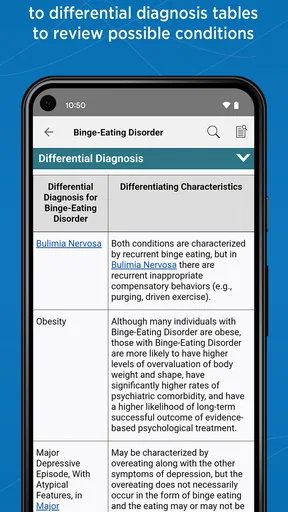
The app’s main appeal is practical: it brings disorder information, diagnostic criteria and differential considerations together in a phone-based reference. In my experience, that arrangement is most helpful when I already have a focused question. If I am reviewing a particular presentation or revising a topic for class, being able to look up a disorder and compare it with alternatives feels more directed than paging through a broad manual without a clear starting point.
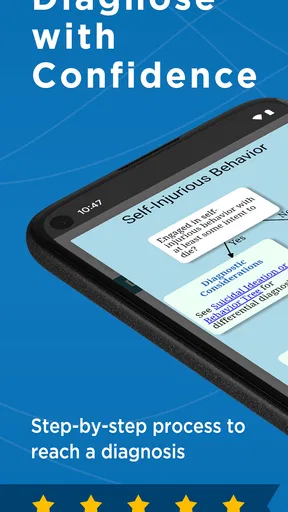
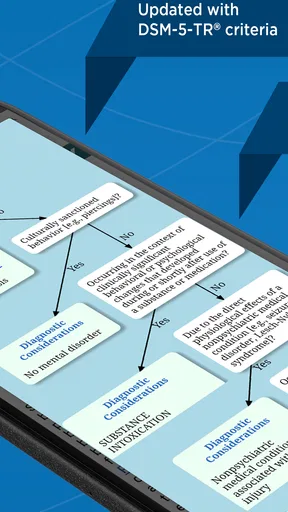
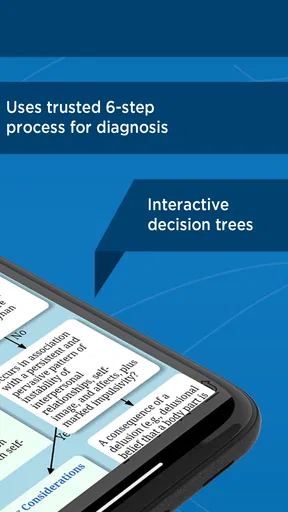
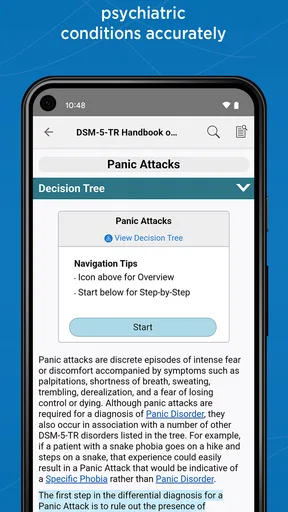
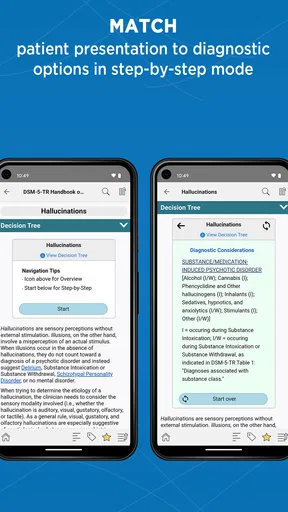
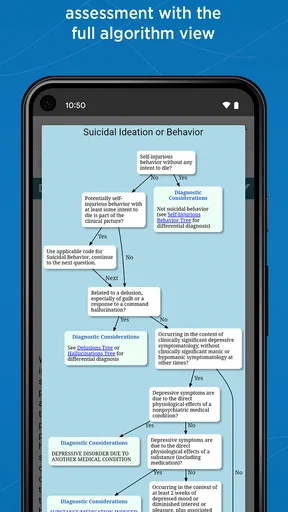
The decision-tree approach is especially worth exploring rather than treating as a novelty. I would use it to make my reasoning visible: identify a candidate, follow the distinctions, and notice which alternatives need more attention. That can be a useful learning exercise because it encourages comparison instead of simple label matching. It is not a substitute for a full assessment, and a tree cannot account for every nuance of a person’s history, circumstances or presentation.
What holds value after the novelty wears off
The lasting value depends less on how often I open the app and more on whether it fits a recurring task. A student could use it to revisit criteria after lectures, check distinctions while making study notes, or test recall with quizzes rather than repeatedly rereading the same material. A clinician may find it useful as a quick reference between more detailed consultations with authoritative materials. In either case, I would get more from it by returning with a specific learning or reference goal than by browsing without one.
For a realistic example, imagine a student preparing for a seminar who is unsure how several possible diagnoses differ. They can look up the relevant entries, work through a decision tree, and then write down the distinctions they still need to verify in class materials. That is a better use than trying to make the app settle a real person’s diagnosis from a brief description. If the question involves risk, uncertainty or a complicated history, I would put the phone away and use supervision, a full assessment and appropriate professional guidance.
Where it fits among the usual alternatives
Compared with a printed manual, a mobile reference is easier to carry and can make a targeted lookup feel quicker, especially when I want to move between a disorder and its differential considerations. Compared with general web searches, a focused DSM-5-TR tool can keep study and reference work closer to a consistent framework instead of mixing formal criteria with scattered summaries. The trade-off is that a compact app is not the same as reading a full source in depth. For coursework, complex clinical questions or checking the exact context around criteria, I would still use the relevant full-length reference and teaching materials.
Worth Reading Before You Choose

EA SPORTS FC Mobile 26 Is a Bigger Football Game, but It Takes Time

Flipboard Shows What News Apps Must Do Beyond the Feed

Switching to Android Auto Means Rethinking Your Driving Routine

Google Calendar Makes a Crowded Week Easier to Manage

Ludo King Makes the Most of the Minutes Between Plans

Baby Panda World Brings Quick Play to Modern Phones, but Its Game Library Feels Busy
I would also be careful about what “free” means in practice. The app itself has a free preview, but in-app purchases can cost $69.99 per item. Before relying on it for an entire course or workplace routine, I would explore the preview and confirm that the specific material I need is available in the version I plan to use. That small check can prevent the frustration of building a workflow around content that is not part of the free experience.
Keeping a useful habit without turning it into busywork
A simple routine is more sustainable than opening a reference app every day without a reason. I would choose one topic from a current course or case discussion, use the app to compare the relevant diagnoses, and then record the unresolved questions outside the app for later review. The quiz option can help check recall, but I would use it as a prompt to revisit material rather than as proof of clinical competence. This approach makes the app part of study, not a replacement for it.
Offline access, described as a convenience of the app, can matter when a connection is unreliable. It makes a reference more practical in settings where I cannot count on Wi-Fi, though I would still make sure I have the material I need available before an important study session. The app’s version is 2.8.47 and it supports devices running OS 9 or later. Those details are worth checking against an older device before making it a regular part of a study setup.
Who should skip it, and what may become tiring
This is not the right choice for someone seeking personal mental health advice, a self-diagnosis tool or a substitute for speaking with a qualified professional. Its subject is diagnostic reference material, and using criteria without training or adequate context can create false certainty. It may also be unnecessary for a reader who only needs occasional, introductory explanations; a trusted educational resource or a conversation with a clinician would be a better fit for that need.
For regular users, the main source of fatigue is likely to be the work required to turn reference material into understanding. Looking up a disorder can feel productive, but repeatedly scanning criteria without comparing cases or checking one’s reasoning can become passive. Decision trees can also feel too linear when a real presentation does not fit neatly into a sequence. I would treat any result as a starting point for questions, not a verdict, and switch to a fuller source whenever the distinctions become subtle or consequential.
First Impressions
When I first opened the DSM-5-TR Differential Dx, I was immediately impressed by its clean and user-friendly interface. No clutter, no unnecessary distractions—just a straightforward design. I could easily find my way around, which is crucial because who has time to get lost in an app when you're trying to sort out complex diagnostic criteria?
The app is designed to help both professionals and students in the field of mental health. Whether you’re a seasoned therapist or a psychology student, this app promises to make differential diagnosis a breeze. And I must say, it delivers on that promise.
Diving Into the Features
One of the standout features is the comprehensive list of disorders. It’s like having the DSM-5 manual condensed into your phone. You can quickly search for any disorder and get a detailed list of symptoms, criteria, and even differential diagnoses. It’s super handy for those moments when you need quick access to reliable information.
Another feature I found particularly useful is the "Decision Trees." These are step-by-step guides that help you narrow down potential diagnoses by ruling out other conditions. It’s a bit like having a diagnostic Sherlock Holmes by your side, deducing the most likely diagnosis from a list of possibilities. It’s not only helpful but also kind of fun to use.
Usability and Convenience
Now, let’s talk about usability. The app is surprisingly lightweight, so it doesn’t hog your phone's memory or battery life. This is a big plus for me since I’m always juggling multiple apps at once. Plus, the offline access is a lifesaver. You don’t have to worry about losing access to critical information just because you’re in a Wi-Fi dead zone.
For anyone concerned about keeping their data secure, the app respects privacy and doesn’t require you to input sensitive information. You can use it with peace of mind, knowing your data is safe.
Learning and Development
For students or those new to the field, the app offers a great learning opportunity. It’s like carrying around a personal tutor who’s always ready to help you understand the nuances of mental health diagnoses. You can even create quizzes for yourself to test your knowledge. It’s a fantastic way to reinforce what you’ve learned in class or on the job.
Final Thoughts
Overall, the app is a useful companion for people who regularly study or work with mental health diagnoses. Its strongest role is as a portable aid for looking up criteria and practising comparisons; its weakest is any role that asks it to replace careful assessment or a deeper source. I would keep it on my phone if those reference tasks recur, but I would not expect it to become valuable through novelty alone. A deliberate study habit, a clear understanding of the preview and paid content, and a willingness to verify difficult questions elsewhere are what make it worth returning to.
In a world where time is precious, having quick access to accurate information is invaluable. And that’s exactly what this app provides. If you’re in the mental health field, do yourself a favor and give it a try. It just might become your new best friend.
Pros
- Comprehensive diagnostic tool.
- User-friendly interface design.
- Regular updates with new data.
- Offline access available.
- Includes detailed guidelines.
Cons
- Limited to mental health disorders.
- Requires medical background knowledge.
- Not available in multiple languages.
- Subscription model can be costly.
- No integration with other health apps.
FAQs for DSM-5-TR Differential Dx
What is DSM-5-TR Differential Dx used for?
DSM-5-TR Differential Dx is a specialized app designed for mental health professionals, providing quick access to diagnostic criteria from the DSM-5-TR. It aids in identifying and differentiating mental health disorders, ensuring accurate diagnosis through an intuitive interface and comprehensive database.
Is DSM-5-TR Differential Dx suitable for non-professionals?
While DSM-5-TR Differential Dx is primarily tailored for mental health professionals, such as psychiatrists and psychologists, it can also be beneficial for students and trainees in the field. However, it may not be suitable for laypersons without a background in mental health.
What features does DSM-5-TR Differential Dx offer?
The app offers a robust set of features including detailed diagnostic criteria, decision trees, and algorithms for differential diagnosis. It also provides access to treatment options and up-to-date research insights, making it a comprehensive tool for mental health assessments.
Does DSM-5-TR Differential Dx require an internet connection?
DSM-5-TR Differential Dx is designed for both offline and online use. While the core content is accessible offline, certain features like updates and additional resources may require an internet connection to ensure the information remains current and comprehensive.
Are there any in-app purchases or subscriptions required?
DSM-5-TR Differential Dx may offer a free version with limited features, but a subscription or one-time purchase might be necessary to unlock the full range of tools and resources. Users should check the app store for specific pricing details and available packages.


